McCullough Foundation study documents the first-ever direct evidence that mRNA “vaccine” genetic code integrates into the human genome.
A young woman rapidly developed stage IV bladder cancer after 3 mRNA shots.
Her chromosome 19 now carries a non-human spike gene sequence — a PERFECT 20/20 bp match.
Via @NicHulscher:
In a Stage IV cancer patient, we identified a vaccine-derived Spike gene sequence chimerically fused into chromosome 19 with PERFECT 20/20 base-pair identity — 1-in-a-trillion chance of coincidence. ⬇️
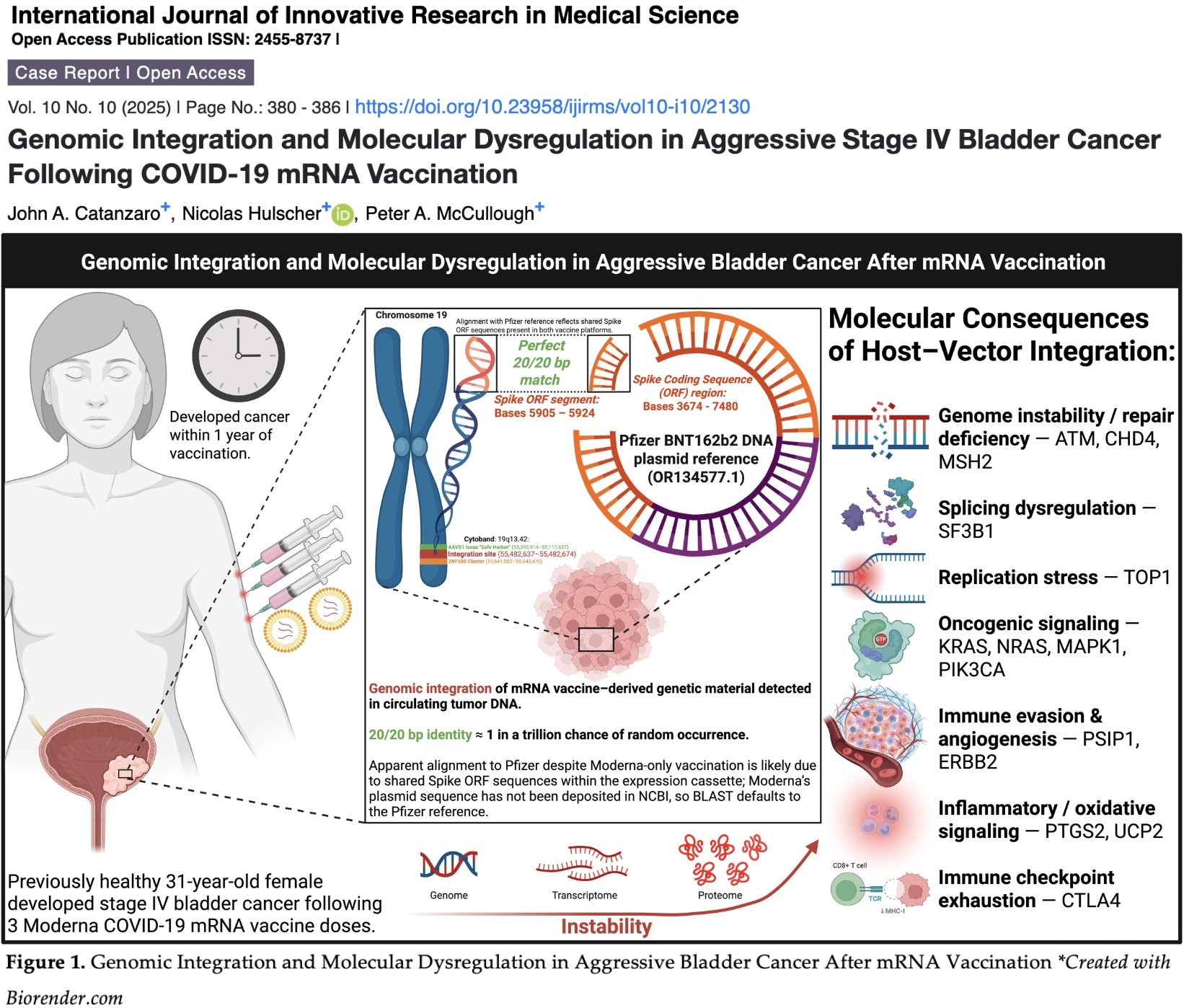
In our sentinel peer-reviewed case report — just published in the International Journal of Innovative Research in Medical Science — we describe a previously healthy 31-year-old woman who developed rapidly progressive stage IV bladder cancer within 12 months of completing a three-dose Moderna mRNA injection series. Bladder cancer is exceedingly rare in young women, and such aggressive presentations are almost unheard of.
To investigate, we performed comprehensive multi-omic profiling, including plasma-derived circulating tumor DNA, whole-blood RNA, and urine exosome proteomics. What we uncovered was striking:
⚠️DIRECT GENOMIC INTEGRATION EVENT: Within circulating tumor DNA, a host–vector chimeric read mapped to chr19:55,482,637–55,482,674 (GRCh38), in cytoband 19q13.42, positioned ~367 kb downstream of the canonical AAVS1 safe harbor and ~158 kb upstream of ZNF580 at the proximal edge of the zinc-finger (ZNF) gene cluster. This sequence aligned with perfect 20/20 bp identity to a segment (bases 5905–5924) within the Spike open reading frame (ORF) coding region (bases 3674–7480) of the Pfizer BNT162b2 DNA plasmid reference (GenBank accession OR134577.1).
Although the patient received only Moderna injections, the sequence aligned to Pfizer’s published BNT162b2 plasmid reference because Moderna has never deposited its proprietary plasmid in NCBI. Crucially, both Pfizer and Moderna vaccines encode the same prefusion-stabilized SARS-CoV-2 Spike protein and therefore share identical stretches of nucleotide sequence within the Spike ORF coding region. It is within one of these conserved regions that the integration was captured, producing the perfect 20/20 bp match to the Pfizer reference.
The probability of a random 20-base sequence perfectly matching a predefined target is ~1 in a trillion. This makes accidental artifact virtually impossible.
Multi-omics profiling revealed:
– Oncogene activation (KRAS, NRAS, MAPK1, PIK3CA, CHD4, SF3B1)
– DNA repair collapse (ATM, MSH2) → genomic instability
– Transcriptomic chaos across plasma, blood, and urineThe convergence of (i) close temporal proximity to vaccination, (ii) genomic integration of a vaccine plasmid–derived spike gene fragment, and (iii) consistent transcriptomic and proteomic instability across biospecimens represents a highly unusual and biologically plausible pattern.
The discovery of spike gene integration directly within a cancer may help explain the surge in post-vaccination “turbo cancers,” as well as emerging signals of transgenerational harm — including excess infant deaths among children of vaccinated parents. Together, these data point to a biologically plausible mechanism linking mRNA injections to oncogenesis and heritable genomic disruption.
These findings demand urgent genomic surveillance, orthogonal validation with long-read sequencing, and large-scale cohort studies to fully assess the genomic and oncologic risks of synthetic mRNA technology.
This evidence compels the immediate withdrawal of all COVID-19 mRNA products from the market. Humanity now confronts the unprecedented threat of vaccine-induced genomic disruption—a danger too great to ignore.
[Via: @Docjohnc @neo7bioscience @P_McCulloughMD @McCulloughFund]